

来源:“逸学科研站”公众号
每天,学术期刊编辑会收到上百封投稿。如果你的Cover Letter还是以千篇一律的“Dear Editor”开头,很可能在打开PDF之前,就已经被划入了“待退稿”堆。
真正高效的Cover Letter,不是礼貌的套话,而是一场精准的“10秒说服”。下面这3个模板,直接帮你把编辑的关注点拉满,大幅提升送审概率。
一、为什么“Dear Editor”已经失效?
传统写法通常是这样的:
Dear Editor,
We are submitting our manuscript entitled “……” to your journal. This work has not been published before…
编辑每天看几十遍这种开头,关键词触发:模板、群发、没有特别之处。而高效的Cover Letter,必须在前3行回答三个问题:
1. 你的核心发现是什么?(一句话说清)
2. 为什么适合这个期刊?(不是群发)
3. 为什么编辑和审稿人会在意?(有新闻性/临床/技术价值)
下面直接上模板。
模板1:重磅发现型——适合有明显创新突破的研究
适用场景:你解决了某个领域长期存在的难题、发现了新机制、或者有高应用价值的成果。
核心逻辑:第一句就抛出“爆炸性结论”,让编辑产生“我必须看看”的冲动。
To the Editor of [Journal Name],
One sentence takeaway: We have solved [long-standing problem] by [your novel approach], achieving [quantified improvement, e.g., 10-fold sensitivity / first-ever visualization / a new mechanism that overturns current theory].
Why this matters: This finding challenges the current understanding that […] and opens a new direction for [application / further research]. Figure 2 alone, we believe, will convince reviewers.
**Why [Journal Name]:** Your recent issue on [related topic] and your readership of [target audience, e.g., clinical oncologists / materials chemists] make this the perfect home for this work.
What we have done differently: We have validated the results with [3 independent methods / in vivo data / replication in two cohorts]. No overlapping or salami publication.
We are excited to submit this work. All authors have approved this submission.
关键点:不要谦虚。直接说“Figure 2 alone will convince reviewers”——这种自信正是编辑想要的。
模板2:完美契合型——适合呼应期刊近期热点或特刊
适用场景:你的研究与期刊近半年发表的文章方向一致,或刚好赶上特刊征稿。
核心逻辑:证明“我不是随机投稿,而是认真研究过你们需要什么”。
To the Handling Editor of [Journal Name],
Connection first: In your [Month Year] issue, you published a call/paper on [specific topic] by [Author Name]. Our work directly extends that conversation by [new angle / contradictory evidence / a missing piece].
Our contribution in one sentence: We found that [key finding], which was previously unknown in [this system / population].
Three reasons for fast-track consideration:
1. Timeliness– [Explain why this finding is particularly relevant now, e.g., new technology just became available, urgent clinical need]
2. Rigor – Pre-registered analysis, raw data and code deposited at [link], two independent replicates.
3. Fit – Directly addresses [mention a specific aim from the journal’s scope statement].
We have not submitted this work elsewhere.
关键点:引用该期刊最近发表的具体文章或作者名字,证明你做过功课。这是最有效的“非群发证明”。
模板3:快速争议解决型——适合回应已有文献或纠正错误认知
适用场景:你的研究挑战了一个被广泛接受的结论,或填补了一个明显的知识空白。
核心逻辑:编辑喜欢“有张力的故事”——前提是你有扎实的证据。
To the Editor,
The challenge: It is widely believed that [common assumption]. However, we have discovered that this is incorrect / incomplete.
Our evidence: Using [method], we show that [your finding]. In fact, [previous model] fails to explain [specific observation], while our model successfully predicts [new outcome].
Why this will attract high impact: This revision forces a reinterpretation of [specific set of prior studies] and will immediately interest researchers in [field A] and [field B].
Conflict transparency: No competing interests. We have cited all relevant prior work, including those we challenge.
We welcome open peer review if the journal offers it.
关键点:不攻击前人,而是说“我们的证据表明需要重新审视”。同时主动提出“开放同行评审”,增加可信度。
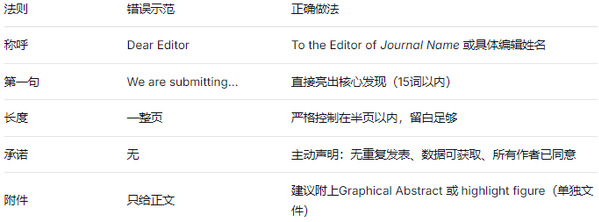
二、三个模板的共同黄金法则
不管用哪个模板,这5个细节决定了编辑是否继续往下看:
三、最后一句最容易被忽视的话
不要在结尾写“Looking forward to your consideration”这种没有信息量的话,改成:
*“If you can identify any technical flaws before review, we would appreciate being informed so we can address them immediately.”*
这句话传递出:我对结果极度自信,不害怕被挑错。编辑会觉得你是个“靠谱的投稿人”。
总结:编辑决定送审,不是因为你“写得对”,而是因为你在10秒内让他觉得“这篇不送审是损失”。选一个最适合你研究的模板,填空,然后发送。你会发现,审稿意见回来得比想象中快得多。